
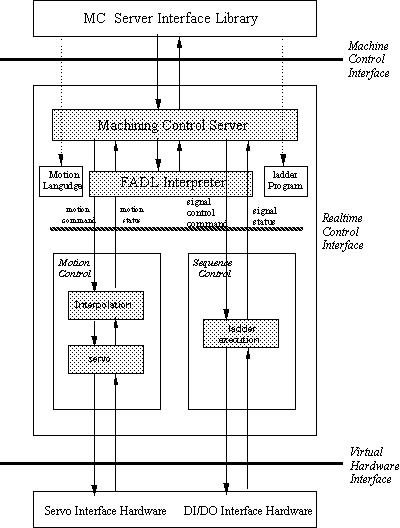
Figure-2.6.5 Example of EMC implementation

Here, we propose four implementation examples of open NC architecture.
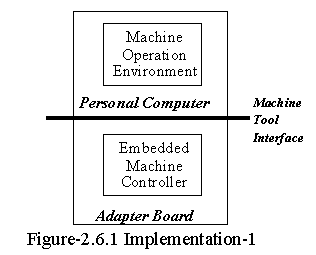
(1) A Machine Operation Environment (MOE) is implemented with a main computer,
and an Embedded Machine Controller (EMC) is implemented with an adapter
board, as in Figure 2.6.1. The roles of MOE and EMC are, respectively,
to provide GUI functions and real-time control. The GUI functions are realized
by a UNIX computer a PC, and the functions of the real-time control are
realized by the real-time OS of the adapter board. In an alternative implementation
of the EMC, it is possible to use the adapter board like the existing motion
controllers.
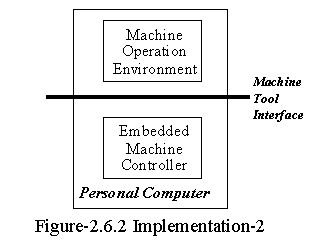
(2) Both the MOE and the EMC are implemented as software in the main computer, as shown in Figure 2.6.2. Though desirable for cost reduction, it is very difficult to integrate both the general OS for the MOE and the real-time OS for the EMC on a single computer. In the near future, there will be a possibility to allocate the MOE and the EMC on separate processors in a multi-processors system.
(3) EMCs can be connected to the single MOE using a network and a computer bus, as shown in Figure 2.6.3. The implementation is suitable when a single operational station handles machine tools such as machining centers and lathes. When these are connected by low speed serial lines, real-time capability cannot be guaranteed. Consequently, response time will become a little slow in program downloading, monitoring and displaying of machining status, etc.
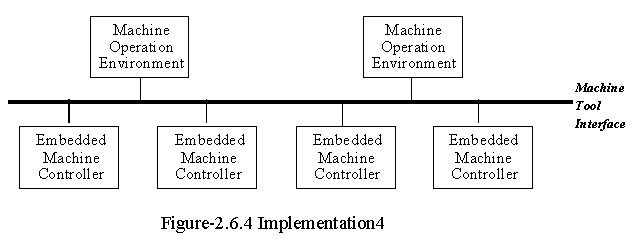
(4) MOEs and EMCs are connected together using a network, as shown in the Figure 2.6.4. The implementation is suitable for FMS and CIM. The response time will depend upon the quantity of communication traffic in the program download, monitoring and displaying of machining status, etc. In this way it is possible to perform remote operations and monitoring of the machine tools.
Figure 2.6.5 shows an example of implementation of the Embedded Machine Controller (EMC). The EMC consists of the following five tasks.
Figure-2.6.5 Example of EMC implementation